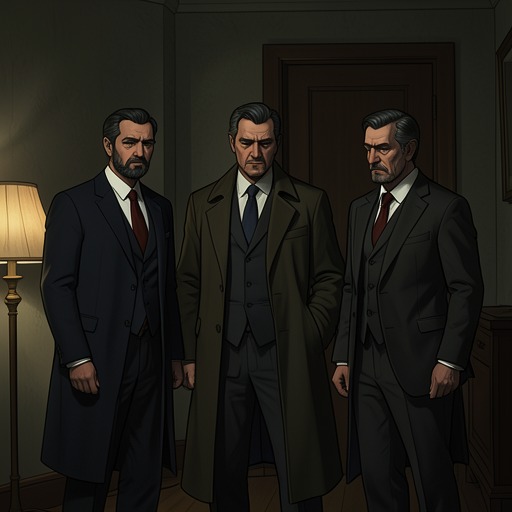
Lucky Girl yacht
Fool Me OnceThe Lucky Girl yacht is where Andrew Burkett was last seen alive and where the unanswered circumstances of his death acquire a possible connection to an earlier tragedy. In the accounts Maya Stern reads and the theory she later hears from Neville Lockwood, the vessel is both a concrete setting—a family yacht crossing the Atlantic—and the point at which grief, celebration, alcohol, and uncertainty converge. The record establishes that Andrew disappeared during the voyage and that his body was found the following day; it does not establish whether he jumped or fell.
Name, Route, and Public Record
Maya finds reports about Andrew by searching for his name and then refining the results with other terms and older dates. A large local newspaper’s headline calls the vessel a yacht and Andrew a scion. She notices both choices: the more prestigious-sounding word for a boat, and the status-marking term previously used for Joe Burkett. The phrasing makes the public account of Andrew’s death about more than a missing passenger; it also reflects the language used to describe the wealthy family to which he belonged.
The reports do not specify the exact point in the Atlantic where Andrew went overboard. They do place the Lucky Girl, on the night he vanished, around the midpoint of its passage from Savannah, Georgia, to Hamilton, Bermuda. That broad location establishes the scale of the uncertainty: the search area was a large stretch of ocean, not a known site that could clarify how Andrew entered the water.
Passengers and Circumstances Aboard
According to the reports Maya reads, Andrew had spent a long night partying with family members and classmates. Joe had previously told her that three of their Franklin Biddle Academy soccer teammates were aboard, along with his sister, Caroline Burkett. Judith Burkett and Joseph, with young Neil, were waiting for them at a hotel in Bermuda; neither parent was on the yacht. The passengers’ circumstances therefore included both a family voyage and a gathering of young people connected through school and soccer.
The newspaper account also names members of the yacht’s cruise staff. Among them is Rosa Mendez, Isabella Mendez’s mother, who was described as being mostly in charge of young Caroline. That detail places a familiar family connection within the otherwise impersonal list of passengers and staff, but the reports do not say that Rosa witnessed Andrew’s disappearance or explain what she may have known about it.
The Disappearance and Its Unsettled Cause
The contemporary timeline is specific even where the explanation is not. Andrew was last seen going out onto the Lucky Girl’s upper deck at 1:00 a.m. on October 24, after the night of partying. He was reported missing at 6:00 a.m. His body was discovered the next day, and later reports listed drowning as the cause of death. The articles Maya finds do not mention either foul play or suicide.
Those omissions matter to the yacht’s place in the story. The upper deck is the last reported point in Andrew’s movements, but no account Maya reads supplies an eyewitness explanation of what happened there. The interval between his last sighting and the report that he was missing, followed by the discovery of his body, gives the event a sequence without resolving its decisive moment. Drowning names the physical cause of death; it does not determine whether Andrew intended to enter the water or fell by accident.
From Theo Mora’s Death to Lockwood’s Hypothesis
Neville Lockwood places the voyage in a longer history. After Theo Mora’s death, the school closed for a week, and Andrew and Joe went home. Lockwood remembers Judith arriving with Andrew’s former nanny to collect them. The boys later returned to campus, but Andrew did not: his mother decided that he should take the semester off. Joe, by contrast, led the soccer team to a successful season, which ended with a celebration on the family yacht.
Lockwood identifies Christopher Swain, Joe’s co-captain, as one of the teammates aboard, though he cannot remember who else was there. He proposes that Andrew’s grief over his best friend’s death, his removal from campus life, and the reminders of that life aboard the yacht may have compounded one another. Lockwood further speculates that Andrew could have been depressed or taking medication, and that alcohol might have interacted with it. In this account, the party and the middle-of-the-ocean setting make a fall plausible; they do not prove that it occurred.
When Maya suggests that Andrew may have committed suicide, Lockwood keeps the explanation conditional. He considers suicide and an accidental fall following a combination of alcohol and medication, then says that either possibility would connect Theo’s death directly to Andrew’s. His conclusion is a hypothesis about cause and consequence, not a finding established by the newspaper reports. Maya’s response is silence, as the proposed link changes the meaning of the yacht celebration from an isolated episode into a possible aftermath of Andrew’s loss.
Narrative Significance
The Lucky Girl yacht gathers two kinds of evidence without making them equivalent. The news reports provide a route, times, passengers, and a recorded cause of death; Lockwood supplies a remembered school history and a theory about Andrew’s state of mind. Read together, these accounts make the voyage legible as the setting of a possible chain of grief, but their gaps remain visible: the precise location is unknown, no witness account explains the last hours, and no evidence in these accounts settles intention.
The vessel consequently serves as a hinge between public record and personal interpretation. Its route helps explain why the circumstances were difficult to reconstruct, while its role as the venue for a soccer-season celebration connects Andrew’s final voyage to the school life he had left behind. The Lucky Girl is not merely where Andrew disappeared; it is where the story’s competing explanations meet, and where the distinction between a documented drowning and an inferred suicide remains unresolved.